

“To plan a city ‘for the world’ is to design as if every resident belongs, because they do. It means streets, schools, housing, parks, and transit are not just local amenities, but the infrastructure of dignity. A city’s success is not only measured in economic impacts or skylines, but in whether people can truly participate and feel welcomed regardless of where they were born, what they earn, or what language they speak at home.”
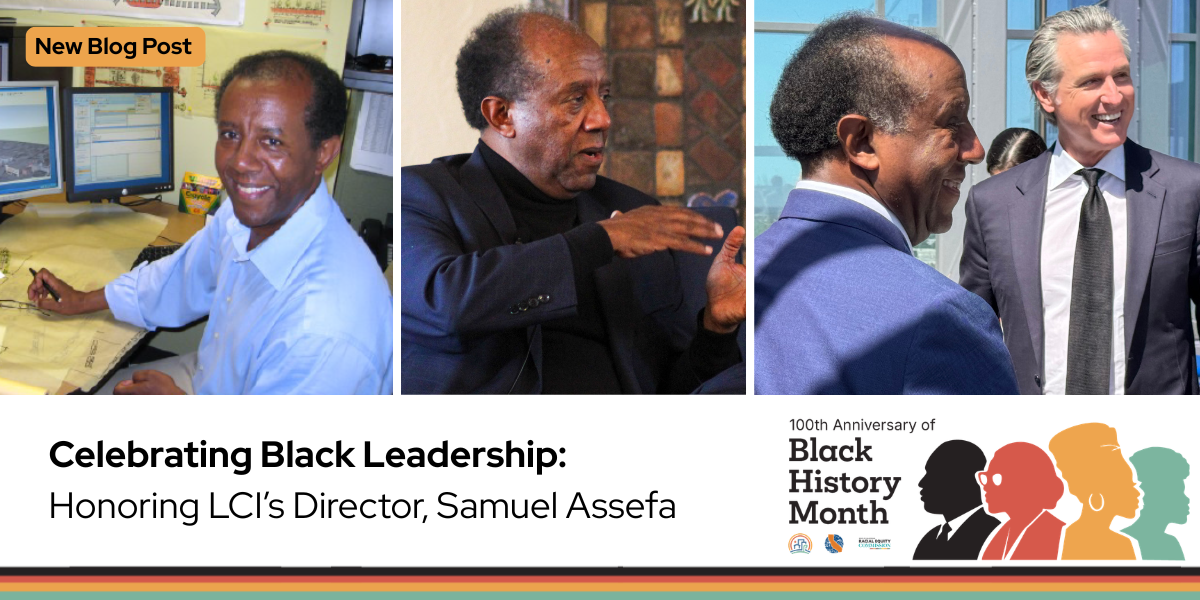
In 2021, the California Governor’s Office of Land Use and Climate Innovation (LCI) — formerly the Office of Planning and Research — marked a historic milestone by welcoming its first Black Director, Samuel Assefa.
As we commemorate the 100th anniversary of Black History Month, we pause to recognize not only the historic nature of his appointment, but the remarkable life journey that shaped the leader he is today.
Director Assefa’s path to public service did not begin in an office or policy classroom. It began in Addis Ababa, Ethiopia.
Raised as the son of Lieutenant-General Assefa Demissie, aide-de-camp to Emperor Haile Selassie, Director Assefa grew up during a time of political upheaval. Following a military coup, members of the emperor’s inner circle — including his father — were executed. At just 17 years old, he fled Ethiopia, traveling overland for weeks to Nairobi, uncertain whether he would ever see his mother again.
At 17, most young people are imagining their futures. Director Assefa was focused on getting through each day navigating how to stay alive long enough to have one.
A chance encounter with a ticket agent in Kenya redirected his path. He stayed in Kenya to attend school — eventually earning a scholarship to the School of Kenya (ISK), a school with a diverse student body representing over 50 nationalities among its 500+ students at the time.
That early exposure to global perspectives, combined with profound personal loss, shaped his quiet, observant, big-picture leadership style.
Planning That Meets Real Life
His passion for land-use planning emerged from an early love of architecture, inspired by designers like Frank Lloyd Wright. He immigrated to Chicago in 1980 to study architecture at the University of Illinois. Here he began his career designing lavish buildings at a world-renowned firm, and although what he was creating was beautifully exquisite, he felt something was missing.
He wanted to shape systems. Not just structures.
“Growing up in Ethiopia, I had a passion for architecture from a young age. After living in Kenya and Italy as a refugee, I immigrated to the U.S. in 1980 where I fulfilled my childhood dream by earning a Bachelor of Architecture degree from the University of Illinois at Chicago and a career in a small award-winning, internationally recognized architecture firm. ... While professionally formative, it wasn’t too long before the scale of excess and material waste I witnessed, coupled with my early awareness of vulnerability shaped by living as a refugee, led me to question architecture’s social purpose. This prompted me to pursue graduate studies in City Planning and Urban Design at MIT, where my work shifted toward city-building rooted in environmental justice and expanding access to opportunity for underserved communities.”
His time at the Massachusetts Institute of Technology (MIT) helped move him around the U.S. and eventually to California.
His work, always focusing on a question California is actively grappling with today: How do we grow in ways that are sustainable, resilient, and fair—without leaving communities behind?
Before coming to California state service, Director Assefa led planning and community development in major U.S. cities, including Seattle, Boulder, Chicago, and San Francisco. Across his work, he has focused on how land use and community development at the city, regional, and national levels can advance environmental sustainability, strengthen livability, and expand access to opportunity for vulnerable communities.
For him, planning was never theoretical. It was about who gets to stay. Who gets squeezed out. Who belongs.
And even amid professional growth, life tested him again. While living in San Francisco, he and his wife, welcomed a son who tragically passed away at eight months old after a failed liver transplant.
Those experiences — displacement, reinvention, grief, resilience — deepen his understanding that communities are fragile, and that policy decisions carry real human weight.
A Global Lens Rooted in Community
Director Assefa has lived on three continents—Africa, Europe, and North America—and he brings that global perspective to local work. He often speaks about what it means to build “cities for the world”: places where people from different backgrounds can feel welcome—not only through housing, but through community spaces, mobility options, and access to culturally meaningful resources.
“My view of community planning is shaped as much by experiences from living in eight cities across four countries and three continents as it is by the rapid globalization of cities that began in the mid-1980s ... While cities have always been centers of trade throughout human civilization, the rapid rise of the ‘global city’ during this period made it clear the need for more thoughtful, values-driven city-making.”
He has described cities as places that must be “worthy of their natural setting” — whether protecting Chicago’s lakefront, Boulder’s mountain backdrop, or California’s diverse landscapes.
He also believes something simpler and more radical: The public process, when done right, will surprise you.
“If people don’t understand, they can’t shape anything that matters … language that turns complexity into choices you can see, move, and debate. It invites informed and proactive community participation in the creation and decision-making process for community plans and development, not polite feedback after the plan is already decided. It put residents in the same working space as planners, engineers, architects, developers, and government, so decisions are made with people, not around them. Power follows understanding.”
Planners must be willing to say, “You were right. We were wrong.”
That humility is part of his leadership.
Black History Month honors legacy — and it honors leadership shaped by resilience.
Director Assefa’s story is not one of symbolism. It is one of survival, scholarship, service, and steady vision — a life shaped by instability that now helps shape stability for millions.
In California, that perspective is not just historic. It is essential.
This Black History Month, we honor Director Assefa not only as LCI’s first Black Director, but as a leader whose life reminds us what thoughtful, inclusive planning can make possible.