
By Akilah Jones, LCI Communications
During National Military Appreciation Month this May, the Governor’s Office of Land Use and Climate Innovation (LCI) is spotlighting the behind-the-scenes work of our Military Affairs Team and the broader partnerships that help strengthen military readiness, community resilience, and statewide coordination across California.
Military service in California is not separate from our communities — it is part of them. Service members, veterans, and military families are our friends, families, neighbors, co-workers, and community and business leaders. Their presence shapes the daily life, resilience, and identity of communities across the state.
California’s military-connected community reflects the state’s diversity, including those from various backgrounds, cultures, regions, and lived experiences.
This month is about honoring service and recognizing how thoughtful planning, cross-agency collaboration, and long-term resilience strategies strengthen both military operations and the safety and well-being of communities that surround them.
Throughout May, LCI will highlight key observances and the people, families, and partnerships that contribute to military readiness and community resilience across California.
LCI’s Role in Military Affairs
LCI’s Military Affairs Team operates at the intersection of planning, resilience, and intergovernmental coordination. Its statewide planning and military compatibility responsibilities have long existed, reflecting a longstanding recognition that California’s growth, infrastructure systems, environmental stewardship, community resilience, and defense missions are closely interconnected. This work includes land-use compatibility, resilience planning, infrastructure coordination, community engagement, intergovernmental liaison work, and support for long-term mission sustainment across California.
Military installations and defense activities rely on surrounding communities for workforce, housing, transportation, utilities, communications, and emergency response capacity, while communities benefit from jobs, innovation, and resilience partnerships tied to those missions.
By working directly with local governments, military installations, and state agencies, the team helps:
- Reduce land-use conflicts near military installations
- Support compatible development and infrastructure planning
- Improve awareness of critical infrastructure dependencies, including energy, water, transportation, and communications
- Strengthen coordination around encroachment, resilience and mission sustainment
- Support planning for risks associated with extreme weather, natural disasters, and human-caused hazards
- Support long-term military readiness and community resilience
Through mapping tools, policy guidance, and technical assistance, and intergovernmental coordination, LCI helps ensure that community growth and military operations can evolve together, rather than in conflict.
This proactive approach reflects a broader strategy: bridging local planning decisions with statewide and national priorities.
LCI helps California’s communities and military missions plan, grow, and adapt together.
Planning for Readiness, Resilience, and Coordination
Beyond land-use compatibility, LCI supports resilience planning and coordination efforts that help prepare communities and military installations for future challenges and disruptions.
These efforts may include:
- Regional coordination across jurisdictions
- Improved awareness of critical infrastructure dependencies and potential vulnerabilities
- Planning for risks associated with extreme weather, natural disasters, and human-caused hazards
- Data-sharing tools that improve awareness and decision-making
- Policy alignment across state, local, and federal partners
- Scenario-based planning exercises (e.g., tabletop simulations)
This work ensures California is not only prepared for today’s needs but better positioned to adapt to tomorrow’s uncertainties.
Partnerships that Support Readiness
The Governor’s Military Council is one advisory and convening component within California’s broader military affairs ecosystem. The Council helps bring together experienced leaders and stakeholders to provide perspective on military-community issues and opportunities.
Formed in 2013 by Governor Edmund G. Brown, Jr., the Governor’s Military Council brings together retired flag and general officers, civic leaders, bipartisan legislators, and senior policymakers who help advise on military and defense-community matters across California.
California’s military-connected communities are essential to our state’s resilience, economy, and long-term readiness. Through thoughtful planning, coordination, and partnership, we can help ensure that military missions and surrounding communities continue to support and strengthen one another.
Sam Assefa, LCI Director and Member of the Governor’s Military Council
California’s Strategic Military Role
The U.S. Department of Defense (DoD) manages significant landholdings in California, including roughly 10% of state’s land area, and employs more than 236,000 people across California. Military connected activities contribute approximately $197 billion annually to California’s economy, representing roughly 5% of the state’s Gross Domestic Product (GDP).
California has the fourth largest economy in the world, and its military installations, ranges and airspace coupled with major ports, logistics networks, research institutions, advanced industry provide a network of critical assets that cannot be replicated elsewhere at a similar scale.
Current Projects
Building on its role at the intersection of planning, resilience, and intergovernmental coordination, LCI’s Military Affairs work is grounded in a set of strategic initiatives that strengthen both California’s communities and its military mission. These efforts reflect a broader approach — one that recognizes military readiness, economic vitality, supply chain security, innovation, and community resilience as deeply interconnected.
To support this role, LCI advances several key initiatives:
California Military Installation Readiness (CalMIR): A statewide effort to strengthen coordination between military installations, local communities, state agencies, and infrastructure partners on readiness, resilience, encroachment, and critical infrastructure issues.
The California Military Energy Opportunity Compatibility Assessment Mapping Project (CaMEO CAMP): An initiative that promotes the compatible siting of renewable energy projects. This effort helps prevent conflicts with military testing, training, and operations while advancing shared state and federal goals related to clean energy and sustainability.
The California Advanced Supply Chain Analysis and Diversification Effort (CASCADE), An initiative that focuses on strengthening the cybersecurity resilience of California’s defense supply chains. By addressing vulnerabilities and enhancing preparedness, CASCADE helps ensure that critical systems and suppliers remain secure and operational.
The California Advanced Defense Ecosystems & National Consortia Effort (CADENCE), designated by the DoD Under Secretary of Defense for Acquisition and Sustainment as a Defense Manufacturing Community, works to help strengthen California’s defense manufacturing ecosystem, expand workforce pipelines, support emerging technologies, and reinforce resilient supply chains aligned with national security priorities.
California Smart Manufacturing Leadership Program: An initiative supporting energy-efficient, secure, and resilient manufacturing across California’s industrial base through smart technologies, automation, workforce skills, and digital modernization.
California Shipbuilding Ecosystem Alliance (CalSEA): A statewide initiative advancing maritime industrial capacity, workforce pipelines, and regional economic readiness aligned with evolving U.S. Navy priorities, helping strengthen shipbuilding, sustainment, and maritime readiness.
Together, these initiatives demonstrate how LCI supports both immediate operational needs and long-term strategic priorities by strengthening installation readiness, compatibility planning, economic awareness, cybersecurity readiness, workforce development, advanced manufacturing, maritime capacity, clean energy compatibility, and resilient defense-supporting ecosystems across California.
In addition, the National Security Economic Impacts Study provides localized, data-driven insights that help communities better understand and plan for the economic impacts associated with defense spending and military installations — supporting more informed decision-making at the regional and local level.
Why Military Appreciation Month Matters
National Military Appreciation Month is not only about recognition — it is also an opportunity to better understand the role military communities play in California and how planning, coordination, and partnership support both readiness and community well-being. It is also an opportunity to educate on the experiences of service members and military families, bring awareness of the challenges they face, and create dialogue about how communities and the state can better support military readiness.
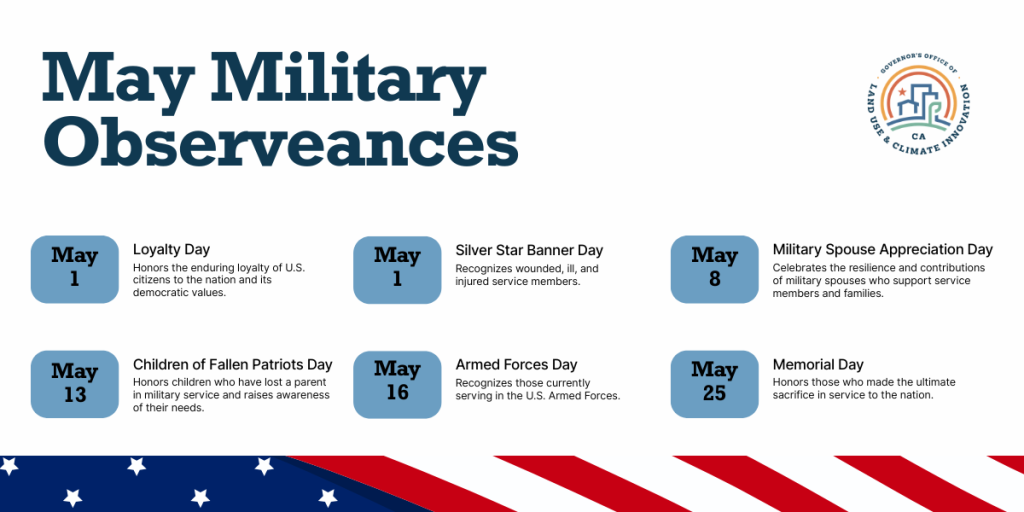
Together, these observances highlight the full spectrum of military service and sacrifice—past and present.
Celebrating Service and Strategy
From advancing compatibility planning to strengthening resilience and coordination, LCI’s Military Affairs work reflects a broader commitment: Supporting military readiness while building stronger, more connected communities.
This Military Appreciation Month, we honor our service members, military families, and the planners, policymakers, and partners working behind the scenes.
Because when California’s military thrives, so do our communities and our future.